Your Cart is Empty

shop


CBD Essentials
CBD + Terpenes
CBD + Terpenes


Soothe Salve +
Serenity Salve +
Synergy Salve +
CBD Essentials


Soothe Salve
Serenity Salve
Synergy Salve
Are you 18+?
Cannabis & CBD Wellness Products for Tension Headaches & Migraine Support
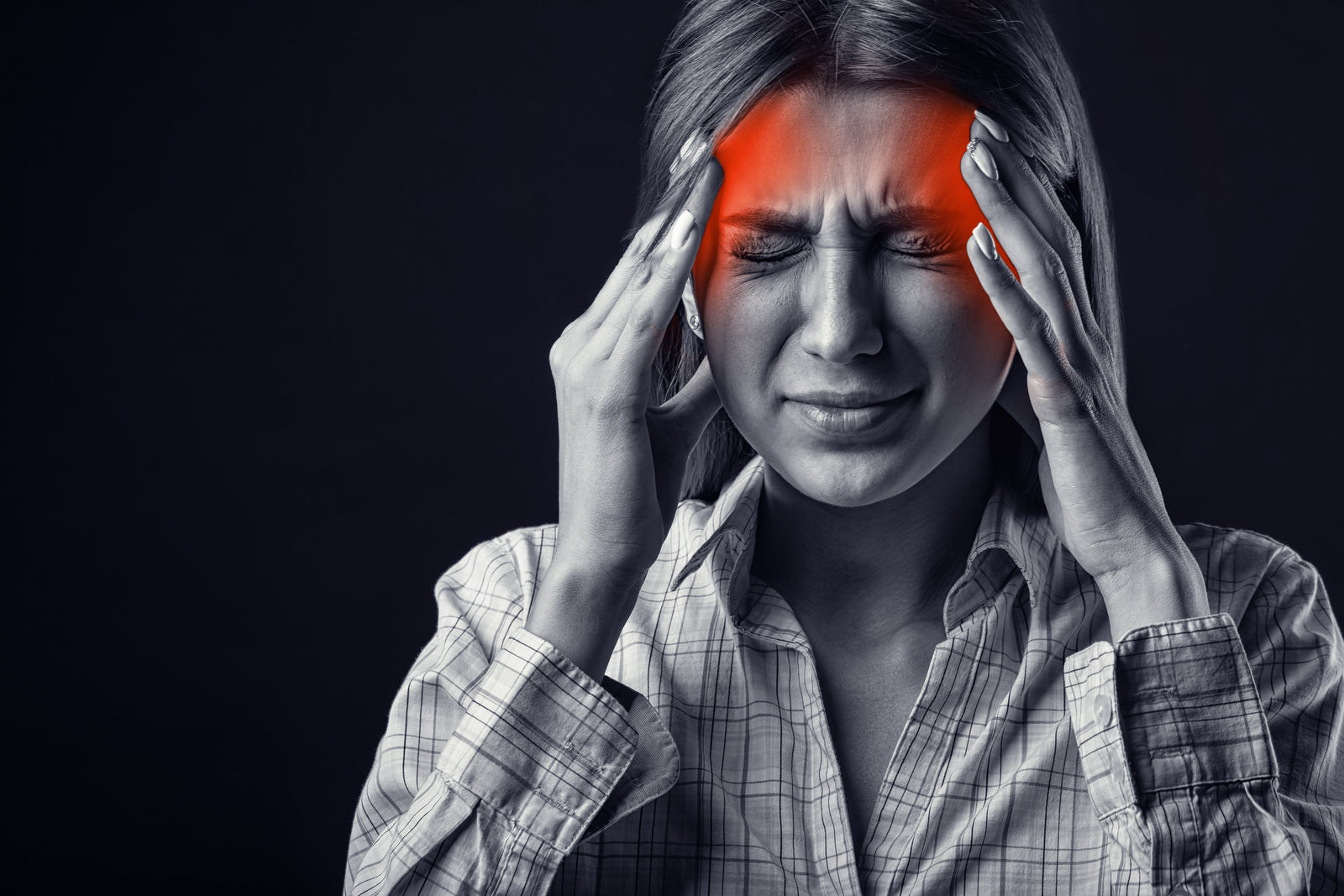

Headaches are close to universal. A 2022 global prevalence review put the share of adults with an active headache disorder in a given year at about 52%, with roughly a quarter experiencing tension-type headache; in the US, the American Migraine Prevalence and Prevention study found a one-year migraine prevalence of 11.7% — 17.1% of women and 5.6% of men.
Cannabis and CBD come up constantly in that conversation. This article is about what the research actually found when people looked, which turns out to be a more useful thing to know than the version most of the category tells.
Let us put the conclusion at the top, because it shapes everything below. Migraine and tension-type headache are neurological conditions with real diagnostic criteria. There is currently no clinical trial of a topical CBD product in people with either one. What our salves are made for is different and more ordinary: the tight, sore neck and shoulders that come from long hours at a desk. If your headaches are frequent, severe, or changing in character, that is a conversation for a doctor rather than a jar of salve.
What the Research Actually Found
Four studies get cited in this space more than any others. Read with their designs attached, they are considerably more interesting than the summaries suggest.
The most quoted is a 2016 retrospective chart review in Pharmacotherapy, which looked at 121 adults at two Colorado medical marijuana clinics and recorded self-reported migraine frequency falling from 10.4 to 4.6 headaches per month. Three things about it. It had no control group and no placebo. The product was THC-containing whole-plant marijuana, not CBD. And patients used several routes at once — mostly inhaled, with the authors specifically crediting inhaled forms with aborting attacks. The authors call for prospective studies before anyone draws a cause-and-effect conclusion.
The review most worth reading is honest enough to say so in its title. “Cannabis and Migraine: It’s Complicated”, published in Current Pain and Headache Reports in 2021, reports that patients using medical cannabis describe improvement in their migraine profile, and then states the position plainly: the research is limited, and not enough data exists for specific dose recommendations. It deals with inhaled and ingested cannabis. It does not discuss topicals at all.
A 2025 study in Cephalalgia is the one most often misrepresented, including by people who should know better. Mice were given intraperitoneal injections of CBD and THC before migraine-like symptoms were induced. A 100-to-1 CBD-to-THC combination reduced light aversion and squinting. Here is the part that never makes it into the marketing: CBD alone had no effect, and THC alone had no effect. The words “topical” and “full spectrum” do not appear in the paper. It is a mouse injection study, and the authors describe their finding as supporting “potential” efficacy.
Then there is the broader picture. The one systematic review devoted to topical and transdermal CBD trials screened 544 papers and found eight, of which only two targeted pain of any kind. Headache and migraine appear nowhere in it. Its warning is the sentence this whole category needs: users “risk generalizing inadequately designed trials to all CBD preparations.”
What Topical CBD Has Actually Been Studied For
Where topical CBD does have human evidence, it is in places worth being specific about. A 2024 systematic review in Pharmaceuticals covering 40 studies — eleven human trials and twenty-seven preclinical — concluded that CBD shows activity against pain and inflammation with therapeutic promise, while noting that the clinical evidence remains limited and that more work is needed to establish which formulation suits which use. Its topical findings concern peripheral neuropathy, thumb basal joint arthritis and hand osteoarthritis. Not heads, and not necks.
The closest anyone has come to this subject is muscular rather than neurological. A 2025 systematic review in the Journal of Clinical Medicine found that topical and intraoral CBD produced promising reductions in pain and muscle activity in people with myofascial temporomandibular pain — jaw muscle, measured by electromyography — while concluding that the evidence supports only “cautious optimism” and calling for higher-quality trials. And a randomised, double-blind trial of 60 people with bruxism found that a CBD gel applied to the jaw muscles nightly for thirty days improved sleep quality and headache-related disability scores compared with placebo.
That last one is genuinely interesting, and it is also not what it might look like. The participants were selected for teeth grinding, not migraine. The measure was a disability questionnaire, not attack frequency. The gel went inside the mouth onto a specific muscle. It suggests that easing muscular tension in the head and neck can matter for how much headaches interfere with life. It is not evidence that a body salve treats migraine, and we are not going to present it as one.
Where a Topical Genuinely Fits
Strip out everything the evidence will not carry, and something useful is still left.
Most people who work at a screen carry tension in the same places: the base of the skull, the tops of the shoulders, the strip of muscle running down either side of the neck. That is not a diagnosis. It is what happens to a body that spends eight hours holding one position, and it is exactly the kind of everyday physical discomfort a topical is made for. You can reach those muscles, you can work a salve into them properly, and the two minutes it takes is itself a break from the screen.
Our desk relief guide covers the rest of that picture — posture, screen height, and the small habits that matter more than any product does.
Choosing a Topical Worth Using
Check the certificate of analysis. Look for a brand that publishes current third-party lab results confirming potency and the absence of contaminants, and that states total cannabinoid content on the label. Every Entourus product carries a QR code that pulls up the current results. Be wary of anyone recommending a minimum strength for effect — there is no established threshold in the literature, and concentration on a label does not predict how much reaches anything.
Read what is left out. A lot of topicals sold for head and neck tension lean on menthol, camphor or arnica. Those produce a strong cooling sensation that does much of the perceived work, and on a neck you are applying to daily, close to your face, it is worth knowing whether you actually want that. Ours contain no menthol, no beeswax and no synthetic fillers.
Match the format to the area. For the neck and the tops of the shoulders, either format works — a body oil spreads more easily across a broad area, while a salve stays put on a specific knot. For most people applying to their own neck, a salve is easier to control.
Pick a scent you will keep reaching for. This matters more than it sounds for anything you use daily. Our formulations are built around cold-pressed essential oils or botanical terpenes, deliberately present without being heavy.
How to Apply It
Take a small amount on your fingers and work it into the base of the skull, down either side of the neck, and across the tops of the shoulders. Slow circular pressure, not a quick rub — a good part of the benefit is the massage itself, and giving it a minute or two is the point rather than a formality.
End of the working day suits most people, or at whatever hour you notice your shoulders have crept up towards your ears. Pair it with the things that actually help a tense neck: standing up, looking at something further than an arm away, and rolling your shoulders back a few times.
Where to Start
The neck and shoulders are sensitive, close to the face, and somewhere you will be applying regularly — which makes the gentlest strength the sensible starting point rather than the strongest. Soothe Salve + is 1000 MG per 50 ML, and sits in the CBD + Terpenes line alongside the two stronger options if you decide you want more later.
We have written separately about CBD alongside mindfulness and meditation and about building a salve into an everyday routine, both of which go further on the habit side.
Every Entourus salve uses full-spectrum CBD from non-GMO hemp grown in Central Oregon. Our CBD + Terpenes line adds a proprietary blend of more than fifty botanically derived terpenes, including limonene and humulene. Both lines come in 1000, 1500 and 2000 MG per 50 ML jar.
Learn more about cannabis topicals on our FAQ.
Mentioned in this guide
Soothe Salve + is the 1000 MG strength in our CBD + Terpenes line — the gentlest of the three, which is what the neck and shoulders call for.