Your Cart is Empty

shop


CBD Essentials
CBD + Terpenes
CBD + Terpenes


Soothe Salve +
Serenity Salve +
Synergy Salve +
CBD Essentials


Soothe Salve
Serenity Salve
Synergy Salve
Are you 18+?
The Future of Hemp Wellness
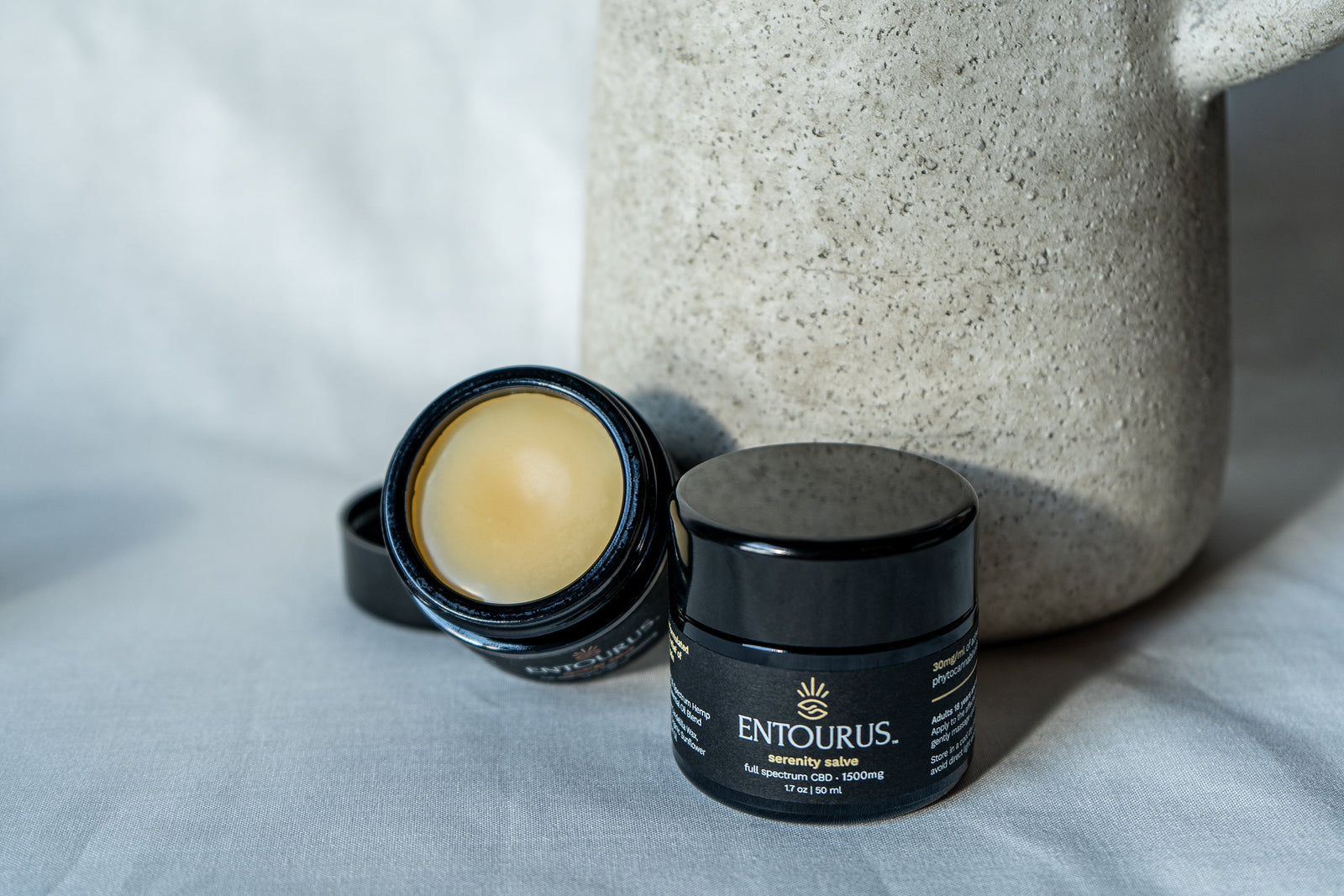

Entourus is a hemp wellness company founded in 2022 in the Greater Boston area. We make topicals — salves and body oils — built on full-spectrum hemp extract and botanical terpenes, and we try to describe them accurately, which turns out to be less common in this industry than it should be.
Our focus is the endocannabinoid system, the signalling network that runs through the body and the skin, and formulations designed to work alongside it. But the thing that actually shapes how we operate is narrower and more practical: the hemp market has a documented honesty problem, and we would rather be measured against it than benefit from it.
Where Our Name Comes From
Entourus is an acknowledgement of the entourage effect — the idea that hemp’s many compounds work together rather than in isolation, and that a whole extract may behave differently from a single purified molecule. It is the reason we formulate around full-spectrum extract rather than CBD on its own.
It is also, honestly, a hypothesis rather than a settled fact, and we would rather tell you that than let the name do work it has not earned. The evidence is genuinely mixed. On one side, a 2024 double-blind human trial found that the terpene D-limonene selectively reduced the anxiety-like effects of THC — one of the first controlled demonstrations in people that a terpene can change what a cannabinoid does. On the other, a 2023 review found the existing studies “in general based on simplistic methodologies” with “contradictory findings,” and criticises companies that use the term to justify a selling point. A 2024 systematic review concludes that terpene enhancement of cannabinoid efficacy remains unproven — and notes that in one test of a topical combination, myrcene plus CBD showed no additional benefit over myrcene alone.
So: an interesting idea, actively investigated, unresolved. We find it a useful way to think about why we use the whole extract. It is not a promise about what a jar will do for you, and anyone presenting it as proven is ahead of the science.
The Problem We Are Actually Trying to Solve
Poor transparency in this industry has led to real confusion about what is in these products and how strong they are. That is not a rhetorical complaint. It has been measured, repeatedly, and the numbers are worse than most people expect.
The study that matters most for a company like ours looked at topicals specifically. Researchers at Johns Hopkins bought 105 hemp-derived topical products — creams, balms, salves, patches, roll-ons — from national retailers and online, and tested what was actually in them. Of those listing a CBD amount, 24% were accurately labelled. Fifty-eight percent contained more CBD than claimed and 18% contained less. THC was detected in 35% of them, including four products marketed as THC free. Twenty-eight percent made therapeutic claims.
It is not an isolated result. The study that first drew attention to this, published in JAMA in 2017, tested 84 CBD extracts sold online and found roughly 70% inaccurately labelled. And a 2024 analysis of 202 CBD products, topicals among them, found 74% deviated from their stated potency by at least 10%, 26% were not even the product type the packaging claimed, and heavy metals, residual solvents and pesticides turned up in a number of samples — some above regulatory thresholds.
Read those three together and the picture is clear enough. In this category, the label is frequently not telling you the truth, and there is no way to know that by looking at the jar.
What We Do About It
Every batch is tested by an independent third-party laboratory, and the results are on the product. Each label carries a QR code that pulls up the current certificate of analysis — cannabinoid content and contaminant screening for the batch you actually received, not a representative sample from two years ago.
A COA does not tell you what a product will do. It tells you what is in the jar and whether the label is accurate. Given the figures above, that turns out to be a real question rather than a formality.
We are specific about what we leave out. Our clean topical standards rule out menthol, beeswax and synthetic fillers. Menthol in particular is worth naming: it produces a strong cooling sensation that does a great deal of the work people attribute to the cannabinoids in cheaper products. Leaving it out means what you feel is the formulation rather than a distraction from it.
We try not to say more than we can support. Across our guides we describe what studies actually tested — the sample sizes, the routes of administration, whether there was a control group — including when that undercuts the sale. There is a lot about topical cannabinoids that is genuinely unresolved, and we would rather be the company that says so.
How We Make Things
Non-GMO hemp grown in Central Oregon. Organic oils and butters chosen for how they sit on skin rather than for cost. UV-protected packaging, because cannabinoids and terpenes degrade in light. Two lines — CBD Essentials and CBD + Terpenes — each at three strengths, so the choice is about coverage area and preference rather than about which tier we would prefer you bought.
Where to Start
The CBD + Terpenes line adds a proprietary blend of more than fifty botanically derived terpenes to the full-spectrum extract, and it is where most people begin.
If you want the detail behind any of the above, we have written about what terpenes are and how they affect CBD products, and about exactly what goes into both of our lines.
Every Entourus salve uses full-spectrum CBD from non-GMO hemp grown in Central Oregon. Our CBD + Terpenes line adds a proprietary blend of more than fifty botanically derived terpenes, including limonene and humulene. Both lines come in 1000, 1500 and 2000 MG per 50 ML jar.
Learn more about cannabis topicals on our FAQ.
Mentioned in this guide
Our CBD + Terpenes line pairs full-spectrum extract with a blend of more than fifty botanically derived terpenes — and every batch carries a QR code to its own certificate of analysis.