Your Cart is Empty

shop


CBD Essentials
CBD + Terpenes
CBD + Terpenes


Soothe Salve +
Serenity Salve +
Synergy Salve +
CBD Essentials


Soothe Salve
Serenity Salve
Synergy Salve
Are you 18+?
CBD Topicals for Better Skin Health: Eczema, Psoriasis, and Dry Skin
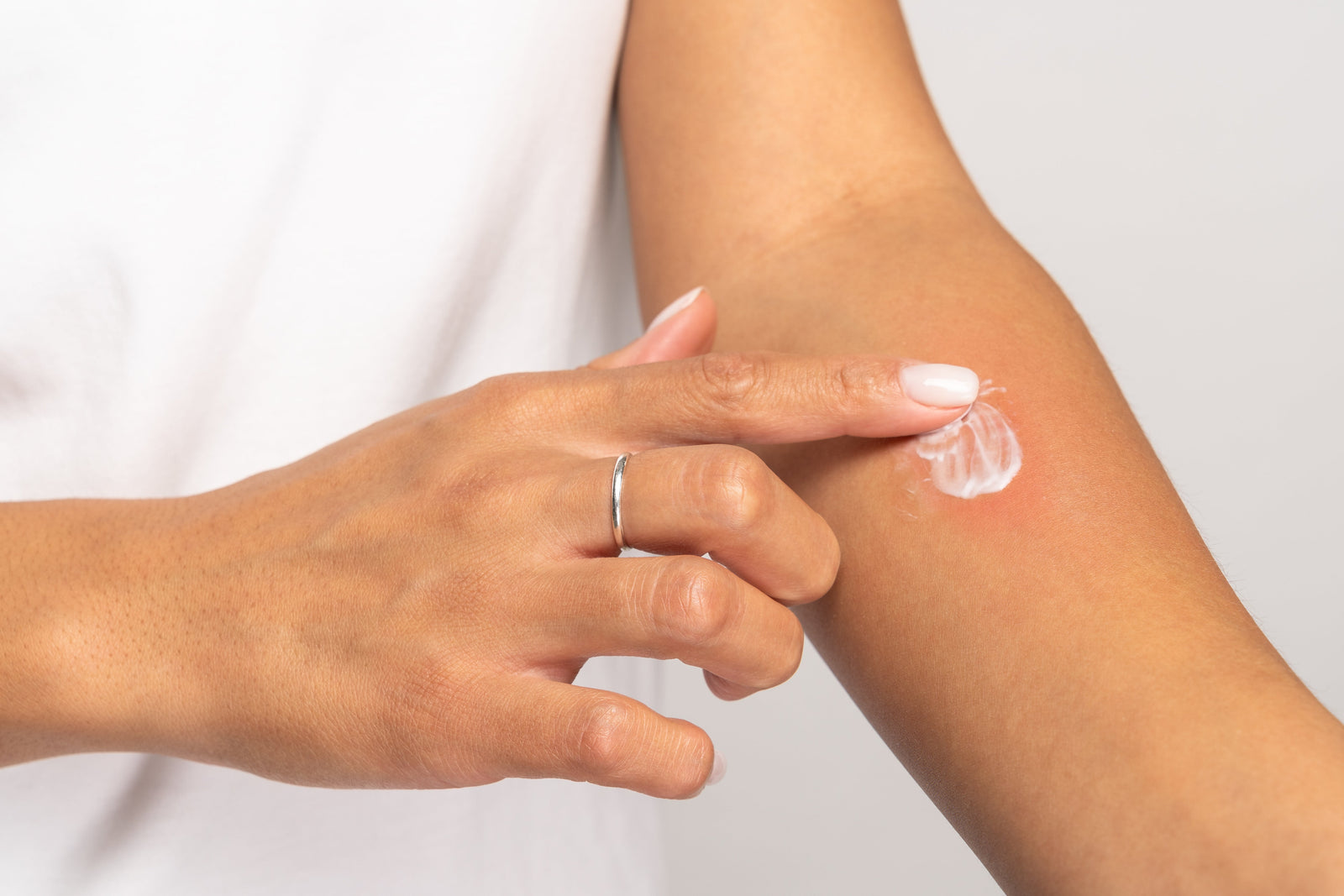

If you have been looking for something to help with irritated, flaky or dry skin, you have almost certainly come across CBD topicals — salves, creams, body oils. The category has grown quickly, and the claims attached to it have grown faster. This guide is the version we would want to read: what CBD actually does in skin, what the research has and has not found for eczema and psoriasis, and what a well-made topical can honestly offer someone whose skin is dry and easily upset.
One thing belongs at the top rather than in small print at the bottom. Eczema and psoriasis are medical conditions. A cosmetic topical is not a treatment for either of them, and if you are managing one, a dermatologist is the right person to be talking to — not a product page. What follows is what the evidence says, including the parts where it is thinner than the marketing suggests.
What CBD Actually Does in Skin
Cannabidiol (CBD) is one of many compounds in the hemp plant. The reason anyone puts it on skin at all is that skin turns out to be a plausible place for it to act: cannabinoid signalling in the skin has been reviewed as part of how the skin maintains homeostasis and barrier function, and cannabinoid receptors are present in cutaneous tissue.
That much is well established. What a finished topical product does on top of it is a separate question, and a much less settled one. A 2020 review of CBD for skin puts the split about as well as it can be put: “it is certain that cutaneous biology is modulated by the human endocannabinoid system”, while noting in the same breath that research confirming the topical benefits is limited.
What the Research Has Actually Found
This is the section most articles in this category skip. Here is the state of it.
Psoriasis. A 2024 review in Psoriasis: Targets and Therapy gathers the laboratory work — cannabidiol reducing inflammatory signalling in cells taken from people with psoriasis, and reducing oxidative stress in cultured keratinocytes — and is candid about where that leaves things: research into CBD’s impact on psoriasis is, in the review’s words, still in its early stages, with large-scale clinical trials still needed.
There is one genuine randomised trial, and it is worth reading closely. A dual-centre, double-blind, placebo-controlled study published in 2022 treated 51 patients on a split-body design, comparing a 2.5% CBD ointment against placebo on matched plaques twice daily for twelve weeks. The CBD side did better, and the difference was statistically significant. It was also small: around 70% of the CBD-treated lesions were still classified as unresponsive at the end, against 79% on placebo. That is a real signal in a properly controlled trial, and it is a long way from what the category tends to imply.
Eczema. The controlled evidence here is thinner still — which is to say there isn’t any. The most-cited human study is an observational study of fourteen people using a 1% CBD gel for two weeks, which recorded a reduction in eczema severity scores and in itch intensity. It had no control group, no blinding and no placebo, and the authors say plainly that large-scale human studies are necessary before CBD can be described as a treatment for atopic dermatitis.
And the counterweight. When someone pooled the numbers, the result was mixed and worth knowing. A 2025 systematic review and meta-analysis in Frontiers in Pharmacology found a modest but statistically significant reduction in itch across cannabinoid studies — and found no significant effect on skin dryness, on redness, or on quality of life, rating most of the included studies at unclear to high risk of bias.
That last finding is inconvenient for a company selling topicals to people with dry skin, and we are including it anyway. The broader picture is the same: the one systematic review devoted to topical and transdermal CBD trials screened 544 papers and found eight, and warns in its own words that users risk generalising inadequately designed trials to all CBD preparations.
Why We Make Full-Spectrum Topicals
Every Entourus topical is built on full-spectrum hemp extract, which means the minor cannabinoids, terpenes and flavonoids come through with the cannabidiol rather than being stripped out. That includes THC, present in trace amounts under the 0.3% by dry weight threshold that defines hemp — far too little to produce any intoxicating effect.
We keep it there deliberately rather than removing it, and it is fair to ask what the evidence for that decision looks like. Honestly: suggestive rather than settled. In a 2022 laboratory study published in Cells, cannabidiol and THC each increased growth and reduced markers of ageing in cultured human skin fibroblasts. Two things to hold onto about that: the compounds were tested separately rather than in combination, and this was cells in a dish, not skin on a person. The authors’ own conclusion is that clinical trials are needed to confirm any effect in people — and the study exists precisely because cannabinoids had started appearing in beauty products without that work being done.
The wider idea that plant compounds do more together than alone — the entourage effect — is the reason full-spectrum formulations exist at all, and it is genuinely unsettled: a 2023 review found the existing studies “in general based on simplistic methodologies” with “contradictory findings.” We formulate around the whole extract because it is the more complete starting material, not because the synergy has been demonstrated.
One practical note if you are drug tested. A 2024 study of five commercially available hemp topicals found no detectable THC in blood, but nine of the forty-six participants recorded oral fluid THC at or above the current US federal workplace threshold. If you are subject to workplace or competitive testing, check your own policy before using any full-spectrum hemp product.
What a Well-Made Topical Can Honestly Do for Dry Skin
Here is the part we can stand behind without a hedge, because it is not really about cannabinoids at all.
Dry skin responds to good emollients, and the base of a topical is what delivers them. Ours are built on organic MCT, coconut, sunflower and olive oils, mango and shea butters, and candelilla wax — ingredients that soften skin, help it hold moisture and leave it comfortable rather than tight. Worth being precise about this, since a great deal of marketing is not: those fatty acids come from the carrier oils and butters. CBD is a single molecule. It contains no fats and no vitamins of its own.
The other half is what is not in the jar, and for skin that reacts easily this matters more than the cannabinoid figure on the label. Our clean topical standards rule out menthol, beeswax and synthetic fillers. Menthol is the one to look for on a competitor’s label if your skin is sensitive — it is the cooling agent doing a lot of the perceived work in cheaper products, and it is a common irritant on compromised skin. No beeswax means the formulations are vegan, and the ingredient list is short enough to read in full.
As with any new product on reactive skin, patch test first: a small amount on the inside of a forearm, and give it a day before you commit to a larger area.
Making It Part of a Routine
1. Start with clean, dry skin. A gentle unscented cleanser, or simply after a shower once the area has dried. Product goes on better and you are not sealing anything in underneath it.
2. Be generous, and take your time. Work it in until it has absorbed. For larger areas — shoulders, back, legs — a body oil spreads more easily than a salve; for a specific patch, a salve stays where you put it.
3. Repeat. A moisturising routine works because it is a routine. Once daily, at the same point, is worth more than an occasional heavy application.
4. Store it properly. Somewhere cool and dry, out of direct sunlight.
5. Keep your doctor in the loop. If you are being treated for a skin condition, tell your dermatologist what you are putting on your skin. A topical you like the feel of sits alongside their advice; it does not replace it.
Where to Start
If dry skin over a decent area is the problem, a body oil is the format — it spreads easily and absorbs without a heavy residue. Synergy Body Oil + (30ML) is the travel size in our CBD + Terpenes line, which is the sensible way to find out whether the formulation suits your skin before committing to the full bottle.
We have written separately about building CBD into a skincare routine and about choosing a CBD product for wrinkles and anti-ageing, both of which go further on the skincare side.
Every Entourus salve uses full-spectrum CBD from non-GMO hemp grown in Central Oregon. Our CBD + Terpenes line adds a proprietary blend of more than fifty botanically derived terpenes, including limonene and humulene. Both lines come in 1000, 1500 and 2000 MG per 50 ML jar.
Learn more about cannabis topicals on our FAQ.
Mentioned in this guide
Synergy Body Oil + (30ML) is the travel-size bottle in our CBD + Terpenes line — no menthol, no beeswax, and an ingredient list short enough to read before you put it on sensitive skin.