Your Cart is Empty

shop


CBD Essentials
CBD + Terpenes
CBD + Terpenes


Soothe Salve +
Serenity Salve +
Synergy Salve +
CBD Essentials


Soothe Salve
Serenity Salve
Synergy Salve
Are you 18+?
Establishing A CBD Regimen

Most people buy a CBD topical, use it enthusiastically for a week, and then it migrates to the back of a drawer. The product was probably fine. The routine was the problem.
A regimen is just a decision made in advance: where you are going to apply it, when, and how consistently. This guide covers how to set one up, what the research supports about giving it time, and how to work out which strength suits you before committing to a full jar.
What CBD Is, Accurately
Cannabidiol is one of the main compounds in the hemp plant, and it is worth being precise about what it does, because a great deal of what gets written about it is not.
CBD does not activate cannabinoid receptors the way THC does. A systematic review in the British Journal of Pharmacology describes it as “a very low-affinity CB1 ligand that can nevertheless affect CB1 receptor activity in vivo in an indirect manner.” You will often read that CBD activates CB2 receptors. It does not — that description belongs to a different compound. Laboratory work published in PNAS identified beta-caryophyllene, a terpene found in hemp and in black pepper, as a selective CB2 agonist. That is one of the reasons we formulate with terpenes rather than cannabidiol alone.
The skin is a reasonable place for any of this to happen: cannabinoid signalling in the skin has been reviewed as part of how the skin maintains homeostasis and barrier function, and cannabinoid receptors are present in cutaneous tissue.
Being straight about the limits, though: the research on finished topical products is thin. The one systematic review devoted to topical and transdermal CBD trials screened 544 papers and found eight. We would rather you knew that going in.
Building the Regimen
1. Pick the spots, not the product. Decide in advance which two or three areas you are actually going to work on — the shoulders and neck after a desk day, the knees and calves after training, hands in the evening. A regimen aimed at “wherever it hurts” is one you will forget. A regimen aimed at three specific places takes two minutes and survives.
2. Attach it to something you already do. The reason evening routines stick is that they are bolted onto an existing habit: after the shower, before bed, after brushing your teeth. Pick the anchor first and the application slots in behind it. Our evening ritual guide sets out the whole sequence.
3. Use enough, and work it in. Most people underuse a salve. A pea-sized amount does not cover a shoulder. Take enough to cover the area, then spend a minute actually massaging it in rather than dabbing it on — the massage is a real part of what you get from the two minutes.
4. Give it time before you judge it. This is the step people skip. A 2024 controlled study of five commercially available hemp topicals found that where CBD was measurable at all, concentrations peaked after seven to ten days of consistent use, not after one application. Whatever a topical is or is not doing for you, a single evening is not the test. Two weeks of daily use is.
5. Store it properly. Somewhere cool and dry, out of direct sunlight. Cannabinoids and terpenes degrade in light and heat, which is why our packaging is UV-protected and why the jar should not live on a sunny windowsill.
Where People Actually Use It
Everyone’s routine looks different. These are the patterns we see most often among people who stick with it:
After training. Applied to the muscle groups that took the load — quads and hamstrings after legs, shoulders after pressing, calves after a run — as part of a cool-down alongside stretching and hydration.
At the end of a desk day. Into the base of the skull, down either side of the neck, and across the tops of the shoulders, which is where screen work concentrates.
On specific joints. A salve stays where it is put, which suits a knee, an elbow or the base of the thumb better than an oil does.
As part of a wind-down. Two minutes of working something into your neck at the same point each evening, as one component of a routine that also includes dimming the lights and putting the phone down.
Finding Your Strength First
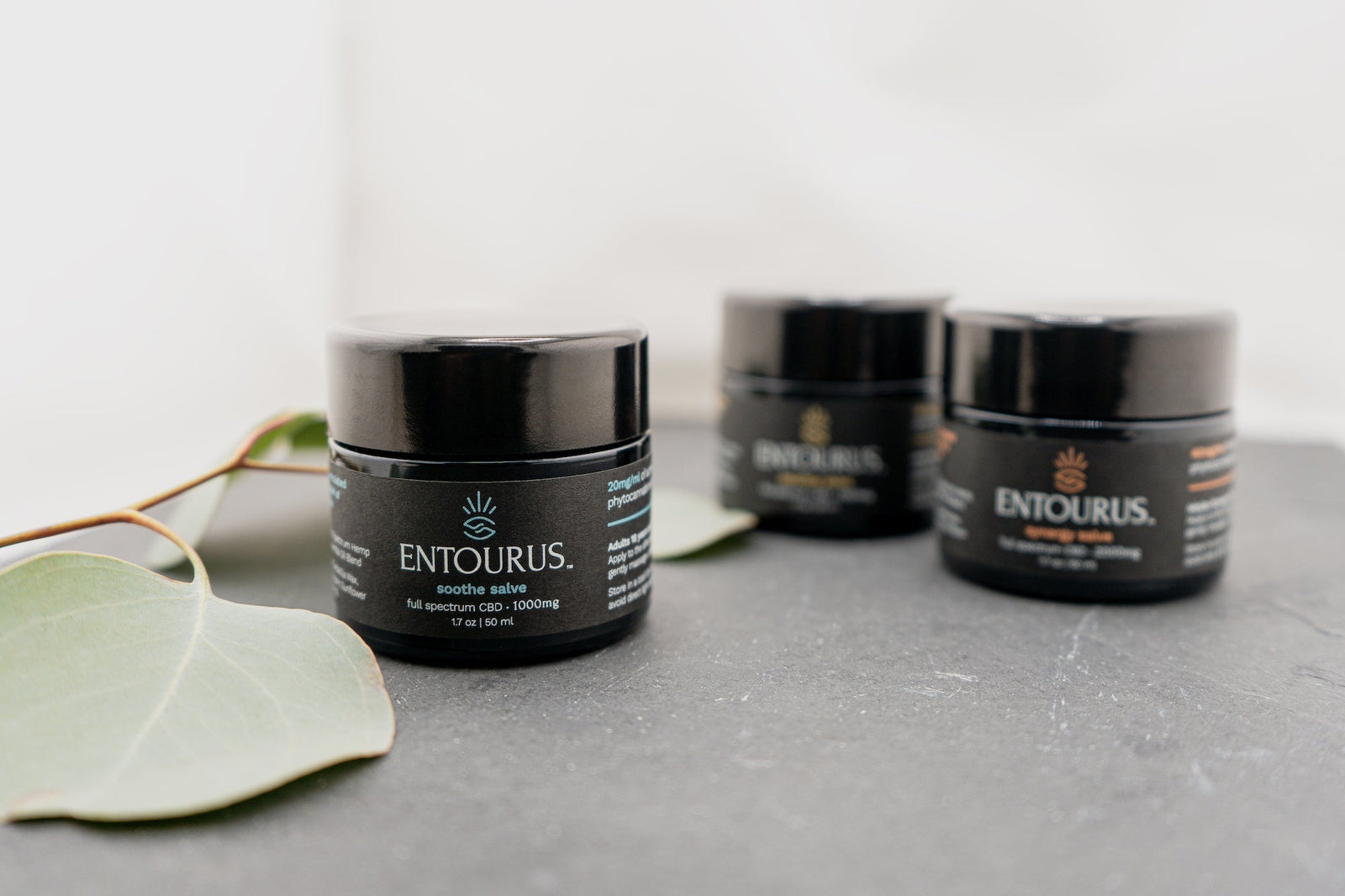
The most common mistake at the start is committing to a full jar of a strength you have not tried. Our salves come in three — Soothe at 1000 MG, Serenity at 1500 MG and Synergy at 2000 MG per 50 ML — and the right one depends on how large an area you are covering and how your skin responds, neither of which you can predict from a label.
The CBD Salve Sample Bundle exists for exactly this: all three strengths side by side for $25, so you can run a fortnight on each and find out what suits you before spending properly. The full range sits in our complete topicals collection.
One practical note: if you are managing a health condition or taking medication, talk to your doctor before adding anything new, topical or otherwise.
We have written separately about incorporating a CBD salve into a wellness routine and about how to choose the best CBD cream, both of which go deeper on the selection side.
Every Entourus salve uses full-spectrum CBD from non-GMO hemp grown in Central Oregon. Our CBD + Terpenes line adds a proprietary blend of more than fifty botanically derived terpenes, including limonene and humulene. Both lines come in 1000, 1500 and 2000 MG per 50 ML jar.
Learn more about cannabis topicals on our FAQ.
Mentioned in this guide
The CBD Salve Sample Bundle is the $25 way to try all three strengths side by side — the sensible first step before committing to a full jar.